
Pastoral letter from Cardinal Nichols

Given as a Pastoral Letter for the Fourth Sunday in Lent (Laetare Sunday), 22nd March 2020
Dear Brothers and Sisters in Jesus Christ,
You need no words from me to state the grave seriousness of the crisis of the spread of the coronavirus around the world and throughout this country. We know the steps and the sacrifices we must take in order to play our part in slowing its spread, saving lives and enabling the NHS to continue its vital work. These things are our duty before God.
There are other vitally important aspects of this moment in our history that are less prominent in our media and conversations.
At this moment we stand before God. That is never to be forgotten. Together we turn to God in prayer, at this moment as never before.
Our faith in God, Father, Son and Holy Spirit, is the bedrock on which we live. Prayer is the first and loving expression of this relationship. Prayer is an acknowledgement that we are not in ultimate control of our lives or of our world. That is so clear at this time. Prayer is the recognition that our lives, individually and communally, are marked by failure and sin. Prayer is an expression of our turning to God for that grace which alone can heal us, strengthen us and give us the resolve and generosity to do all that is rightly expected of us today. Please make this a time of prayer, personally, in the family and wherever you happen to be.
The highest form of prayer is the celebration of the Holy Mass. This is at the heart of the rhythm of the life of the Church, the rhythm of prayer which sustains us all. The present crisis will not disturb that rhythm. Mass will continue to be celebrated, day by day. The prayer of the Church will continue day by day.
What will change is the manner of our participation in those celebrations of the Mass. In response to the pandemic and the official guidance, which we must follow, public participation in the celebration of the Mass is not, for now, possible. This is a sacrifice we have to make. It is not easy, for any Catholic, but it is what we must do.
I want to make it exceptionally clear that the teaching of the Church is that, in these circumstances, the obligation of attending Mass on Sundays and Holy Days no longer applies. Please have no doubt about this.
This does not mean that we lose our love of the Mass or our desire to take part in the celebration of the Mass. Mass will be celebrated, day by day, in your church. There are many ways of taking part in this prayer. Associate yourself with the celebration of the Mass spiritually. Read the Scriptures of the day. Use some of the materials that are available to be close in your heart. Learn again the practice of spiritual communion. If you are helped by a visual participation in the Mass, then go to one of the websites on which that celebration is being streamed. The list of those websites is available to you. There are many ways in which we can deepen our participation in the Mass and our life of prayer in these strange and stressful days. Indeed, they are an opportunity for us to do so.
Two other points.
Being unable to attend Mass is the experience of many, many Catholics around the world. They are deprived of the Mass through distance, or through violence, or through persecution. We can unite our experience with them and, like them, return to the Mass with fresh love and enthusiasm when, again, it is possible for us to do so, in bigger numbers than ever.
Secondly, you understand well that from our prayer, and from the prayer of the Mass, flows the love and compassion which we want to show to those around us who are in need. Jesus gives himself entirely for us in his sacrifice, the sacrifice made present again for us in every Holy Mass. What we receive from him we offer to others. So please do look out for every way in which you can help those in need around you. Thank you.
We know that this time of crisis is not going to be brief. We are involved in a lengthy battle. We encourage each other. We pray for each other. Together we turn to Mary for her special protection, especially on 29th March when again, in keeping with our ancient tradition, we offer ourselves and our country to her, as our gift, and seeking her protection.
Mary, Mother of Jesus, pray for us
Mary, Mother of Sorrows, pray for us
Mary, Mother of Joys, pray for us.
Amen.
Yours devotedly,
Cardinal Vincent Nichols
Archbishop of Westminster
PS, I was given this prayer a few days ago. It touched me deeply. It is a prayer for our times:
Dear Guardian Angel, go for me to the church, there kneel down at Mass for me. At the Offertory, take me to God, and offer him my service: What I am, what I have, offer as my gift. At the Consecration, with your seraphic strength, adore my Saviour truly present, praying for those who have loved me, for those who have offended me, and for those now deceased, that the blood of Jesus may purify them all. During Holy Communion, bring to me the Body and Blood of Jesus uniting him with me in spirit, so that my heart may become his dwelling place. Plead with him, that through his sacrifice all people throughout the world may be saved. When the Mass ends, bring home to me and to every home, the Lord's blessing. Amen.
We are still surrounded by the angels and by the saints who are glorifying God and protecting and assisting mankind. Why should we not make them our particular friends and allies in situations where we are touching limits that we cannot overcome?
Prayers during troubled times
As fear grips our country, let us choose love.
During this time when we cannot physically wrap our arms around each other,
let us yet find ways to be the loving embrace of God to our neighbours

We’re inviting Religious to send us prayers and reflections which we can share via this website as we seek to support each other during this most difficult time. This page will be updated regularly with new offerings. Please email to : communications@corew.org
Prayers for the Pandemic: for a household in lockdown
God of the indoors,
who knew the confines of domestic space
at a time of little comfort,

help us in this time of confinement,
help us to see it as an act of love, in solidarity
with those who care for us and put their own lives
on the line for the sake of others.
Help us to ‘make room’ for each other, even if room is scarce,
help us to find reserves of patience we never knew we had,
to take offence less easily, to find in our hearts
an easy apology when we’re petulant.
Help us to be attentive, careful, and thoughtful.
May we draw deeply from the well
of our most loving times.
Prayers for the Pandemic: for those who are anxious

God of Gethsemane,
who knew deep anxiety,
the desire for the cup to be taken away,
your sweat dropping onto the clay of earth like blood,
be with those who suffer at this time
from anxiety, the fear of their world
running out of control.
The facts alone
fan the embers of anxiety
in all of us: the grim daily numbers,
the fear of falling ill, of facing our end.
In our loneliest darkness,
in the night of our Gethsemane,
may we find you there

Prayers for the Pandemic: for the keyworkers
God of a day’s work,
who knew the early start,
the long shift, the thankless task,
help us to ‘see’ keyworkers in the pandemic
in a new and lasting way –
the ones who leave home to mingle
with the virus
to keep us fed,
keep us safe, keep us clean,
to care for us: in school, in care, in intensive care;
help us to help them by being careful ourselves
and remembering, on the other side of this,
who deserves our esteem, our national applause,
our lasting care.
Prayers for the Pandemic: for those who miss going to church
God of the last supper,
who knew real presence: a beloved one
reclining into you, holding dusty feet as you poured water

over them, the tug at the hem of your garment,
touch us now, unable to receive
your risen body in church, unable
to gather as your body;
touch us with your word,
handed on from your mouth, from memory,
written down, broken and shared over centuries
from the pulpit, the kitchen table; touch us
with the glimpses we can see of spring,
of our vulnerable brothers and sisters,
of your presence within.
Prayers for the Pandemic: A Morning Prayer for a School Community
God our loving Father

we gather together this morning
but it’s not the same: many of us are not here
and there is distance between those who are –
not the distance of fear or mistrust,
but the distance of care, of thoughtfulness,
the distance that will help us to stop the virus from spreading.
We pray for friends and classmates who are at home.
We know we will see them again in real life
and value their real presence even more, the gift of friendship.
Help us to ‘see’ more clearly what is important,
the good things we had perhaps overlooked,
the small details of everyday life,
graced with your presence.
We pray for a better world to come out of this –
more grateful for the people who do the ordinary jobs,
more just in the way people are treated, more caring for the vulnerable.
We pray for a world which is more determined
to look after the earth, our common home;
a world that will live wisely, think deeply,
love generously.
We make all our prayers through Christ our Lord. Amen
( Raymond Friel )

Let us pray for all those who have been infected by Covid-19,
for all who fear infection,
for those who cannot move freely,
for the doctors and nurses who concern themselves so generously with those who are sick,
for the researchers who are looking for protective and curative medicine,
that in this crisis of our world God will give us His blessing.
(Silent prayer)
Almighty God, you are our refuge and strength!
Many generations before us have known You as powerful in all their needs.
Help all who are affected by this crisis,
and strengthen in us the belief that You will take care of each and every one of us.
We ask this through Christ, our Lord.
Pope Francis 27 March 2020:

"In these days there's so much suffering. There's a lot of fear... The fear of the elderly who are alone in nursing homes, or hospitals, or in their own homes, and don't know what will happen. The fear of those who don't have regular jobs and are thinking about how to feed their children. They foresee they may go hungry. The fear of many civil servants.
"At this moment they're working to keep society functioning and they might get sick. There's also the fear, the fears, of each one of us. Each one knows what their own fears are. We pray to the Lord that He might help us to trust, and to tolerate and conquer these fears."
Prayer for a Pandemic

May we who are merely inconvenienced,
remember those whose lives are at stake.
May we who have no risk factors,
remember those most vulnerable.
May we who have the luxury of working from home,
remember those who must choose between preserving their health or earning their rent.
May we who have the flexibility to care for our children when their schools close,
remember those who have no options.
May we who have to cancel our trips,
remember those who have no safe place to go.
May we who are losing our margin money in the tumult of the economic market,
remember those who have no margin at all.
May we who settle in for a quarantine at home,
remember those who have no home.
As fear grips our country, let us choose love.
During this time when we cannot physically wrap our arms around each other,
let us yet find ways to be the loving embrace of God to our neighbours.
Amen.
“And the people stayed home:
“And the people stayed home.
And read books, and listened, and rested, and exercised, and made art, and played games, and learned new ways of being, and were still.
And listened more deeply. Some meditated, some prayed, some danced. Some met their shadows.
And the people began to think differently.
And the people healed.
And, in the absence of people living in ignorant, dangerous, mindless, and heartless ways, the earth began to heal.
And when the danger passed, and the people joined together again, they grieved their losses, and made new choices, and dreamed new images, and created new ways to live and heal the earth fully, as they had been healed.”
-Kitty O’Meara

IN ADDITION, COREW HAS BEEN INVITED TO SHARE THE FOLLOWING:
Dear Sisters and Brothers,
You may or may not be familiar with our Emmaus Online Video Prayer and Meditation Library?
However, we have received requests from some of our members to extend access to our resources to communities, parishes and various ministry networks, by way of offering some spiritual support to people during the pandemic and to also help them celebrate Holy Week and Easter.
In response to this need we have prepared a complimentary resource kit of online videos and music downloads for children and adults.
Follow this link for access to the kit: Spiritual Resource Kit
You are welcome to send this link for the resource kit to your Congregational members, not only for their own use, but also for them to send out to their family, friends, colleagues and networks.
We hope and pray that these resources offer some spiritual comfort and nourishment to you and your communities.
Blessings to each of you during this very distressing time of uncertainty and concern.
Emmaus Productions

Cardinal Michael Fitzgerald: we are not alone, because we work together
We can say: All you works of the Lord - all you works of religious institutes - O bless the Lord, to God be highest glory and praise for ever.

The Conference of Religious of England & Wales had been due to celebrate the opening of its new offices at Euston, with a Mass celebrated by Cardinal Michael Fitzgerald, on March 26th. We instead join in prayer for an end to the pandemic. Cardinal Michael has kindly shared the homily that he would have delivered to mark this new chapter in Corew’s life:
Dear Sisters and Brothers in Christ,
Due to the COVID-19 crisis there will be no gathering on this day. The blessing of the new office for COREW will be scheduled for another day which we hope will not be too far in the future. Here in the meantime is a reflection on the gospel passage that we would have heard during the celebration of the Eucharist (Jn 5: 31-47).
“Were I to testify on my own behalf, my testimony would not be valid.”
These are striking words, even more so when we realise that they were spoken by Jesus himself. Jesus says quite clearly that he cannot bear witness to himself. In fact, the concern of Jesus was to announce the Kingdom of God. He proclaimed this Kingdom, for instance in what could be called his manifesto, when he declared: The spirit of the Lord has been given to me, for he has anointed me. He has sent me to bring the good news to the poor, to proclaim liberty to captives and to the blind new sight, to set the downtrodden free, to proclaim the Lord’s year of favour (Lk 4:18).
He announced the Kingdom by fulfilling this prophecy through his miracles of healing. Jesus first appeals to the testimony of John the Baptist, the Precursor, who bore witness to him. But he also testifies to the witness of the Father who has sent him and who is always with him, the Father who through the Spirit allows him to perform the works that render testimony to him. It seems to me that these words of Jesus have considerable importance for us who, as religious, wish to be his true disciples.
First, we cannot testify on our own behalf. We are not called to bear witness to ourselves, or even to our own respective institutes. We are called to announce the Kingdom of God, by our words, but even more by our deeds. Attention is not to be focused on ourselves, but on those to whom we are called to reach out: the poor whom we serve, bringing them at the same time assistance and encouragement, approaching them with respect and love; the captives whom we wish to help in order that they may be free, whether they be prisoners, or victims of human trafficking, or simply people completely immersed and bound up in material things; the blind whom we care for, helping them to negotiate the difficulties of life, but also children and young adults – or perhaps even not so young adults – whose minds we help to broaden through education, giving them new sight; the socially deprived whom we assist, helping them to stand on their own feet, giving them new dignity.
We can say: All you works of the Lord - all you works of religious institutes - O bless the Lord, to God be highest glory and praise for ever.
Secondly, we are not alone in giving this testimony. We can call on the witness of our predecessors, the Founders and Foundresses who have passed on to us their charisms, charisms which we have made our own and which we try to live by. We acknowledge too all the members of our Institutes, those who have gone before us and those still with us, whose example strengthens us. We recognize the role of many who do not belong to our Institutes but who play their part in building up the Kingdom of God. We are not alone, because we are part of the Church, and we are conscious that we are called to play our part, however small, in this Body of Christ which is a sign of union with God and of the unity of the human family.
In the third place, we are not alone, because we work together. We share information and ideas, we learn from our experiences, we collaborate in joint ventures. And we are grateful for those of our members in this Conference of Religious of England and Wales who offer their services so that we may always work together better and better.
Finally, like Jesus we know that we are not alone, because if we remain in him, if we continue to let ourselves be led by his Spirit and strengthened by this same Spirit, we are united with the Father.
We can say with Jesus: “As for human approval, this means nothing to me.” We are not looking for praise, for ourselves or for our religious bodies. We are simply working for the coming of the Kingdom of God, to whom be praise for ever and ever.
Amen.
Contacting us during the coronavirus crisis
We have closed the office but are available on email for all queries:

CoR’ s new headquarters outside Euston station
A message from the General Secretary:
We have closed the office but are available on email for all queries:
So much has happened within the past month. We have settled into our new offices where we hope that, in due course, many of you will visit. Many thanks to the Poor Servants of the Mother of God, who have warmly welcomed us into St Philomena’s and whose sisters have worked so hard to ensure everything went smoothly. Thanks also to all those who helped us move and sent cards, flowers and good wishes.
We had scarcely unpacked and had been working hard on the events planned for March: three Laudato Si’ days of reflection, a digital conference and the celebration, with Cardinal Michael Fitzgerald, of the new chapter in CoR’s life, when we were overtaken by events. Like people around the country we have had to cancel our remaining events in March and will keep other things planned for later in the year under close review. While this is disappointing, what we are facing is minor when we consider the impact of Covid 19 on others. It is of course difficult not to worry about what might happen to family, friends, colleagues and our communities. Padre Pio’s saying: ‘Pray, hope, and don't worry. Worry is useless. God is merciful and will hear your prayer’ seems especially apposite.
I hope you and everyone in your communities stays well and that you find new and creative ways to exercise your ministries during this period.
Valerie Nazareth
CANCELLED MEETINGS:
CoR Celebration : 26th March
Digital Conference : 28th March
Because the office is closed, correspondence and cheques will be processed at a later date. For any queries please email the Secretariat as follows:
Valerie Nazareth: gensecvn@corew.org
Charlotte Vassallo: admin@corew.org
God of healing and mercy, be with the people around the world who have contracted the coronavirus. Comfort those whose loved ones have died. Relieve the anxiety of those worried about their livelihoods and about exposure to the virus and protect those who risk their own lives daily to provide help and assistance to the sick. Through Christ our Lord.
"Pope Francis is asking us to see that destroying the environment is a sin"
…..Fr Sean writes with passion and a deep sense of urgency. As individuals and as institutions, we must make choices in favour of life. This is a prophetic call, calling for a radical change in the way we view ourselves in relation to the rest of creation.


Father Sean McDonagh, a renowned ecological theologian, is the keynote speaker at a forthcoming day of reflection on Laudato Si’ being held by the Conference of Religious in London. Due to the Coronavirus outbreak, the meeting will now take place later in the year.
In 2014 and 2015, Fr Sean was involved in the research which led to the publication of ‘Laudato Si’ On Care for our Common Home.’ The following year he published a book on the encyclical and in 2017 he edited a book entitled ‘Laudato Si’ An Irish response.’ (published by Veritas).
The reflection day aims to help congregations consider quantifiable steps so that Religious will be in a position to lend their prophetic voice to the urgent climate crisis.
Review of publications by Fr Sean McDonagh:
Fr Sean was born in Nenagh, Ireland, studied for the priesthood in St. Columban's College, Dalgan Park, Navan (ordained 1969), and was sent as a Columban missionary to Mindanao in the Philippines the same year. After working among the lowland people in Oroqueita City, Misamis Occidental, Mindanao for four years, he studied linguistics and anthropology in USA.
On returning from Washington DC, he taught at the Mindanao State University in a predominantly Muslim area, and then moved to Lake Sebu to work among the mountain people called the T’boli. In response to the destruction of local forest in T’boli country, Fr Sean began his ecological activism, which culminated in the pioneering book ‘To Care for the Earth’ (1985), though it took three years to find a publisher because the connection between ecology and theology was not well known. ‘To Care for the Earth’ called for a new theology which would give at least as much prominence to creation as to redemption. Fr Sean argued that the grammar of this new creation theology ought to be the findings of modern science. This new cosmology developed from the insights of Teilhard deChardin and Thomas Berry ought to become the guiding myth for modern humankind, especially in the way we relate to the earth and other creatures.
In 1990 this volume was followed by ‘The Greening of the Church’ which revealed that, while Catholic teaching was strong on social issues, it needed to promulgate a supplementary message about the destruction of God’s creation. The focus this time was on developing a theology of creation from the resources of the Biblical tradition to complement the cosmological approach.
His second book, moreover, contained the first environmental pastoral letter of any Catholic Conference of Bishops. It was entitled What is happening to our beautiful Land? and it had a major impact on the Philippine Church. Social justice programmes are no longer confined to addressing human rights abuses or working for a more equitable society. They now include concern for the environment. In the Philippines this means protecting what is left of the tropical forests, mangroves and coral reefs. The pastoral letter was also printed and distributed by the Philippine Department of the Environment and Natural Resources (DENR). Fr Sean was the main drafter of this document, which was published in 1988.
‘Passion for the Earth’ (1995) contains a critique of multilateral lending and trading bodies (World Bank, IMF, GATT-WTO) and their effects on development and the environment. Third world debt was his particular focus.
In 1999 ‘Greening the Christian Millennium’ appeared. It reflects on the ethical and ecological implications of genetic engineering in the plant world and on the patenting of life. Fr Sean argued that a human-centred ethical framework, that has dominated Western thought for almost 2,000 years, was unsuitable for discussing issues like genetic engineering. While supporting laboratory research in genetic engineering he maintained that current field trials and the commercial planting of genetically engineered crops breached the precautionary principle and posed a danger to human health and the environment. Furthermore, he opposed patenting living organisms such as seeds or animals viewing this as a new form of colonialism whereby the North, which is financially rich but poor in biodiversity, is able to commandeer the rich species and genetic resources of the South.
‘Why are we Deaf to the Cry of the Earth’ was published in 2001 and looked at environmental challenges facing Ireland today after six years of unprecedented economic growth.
‘Dying for Water’ was published in 2003. It explores the crisis the world faces both in terms of access to fresh water and the destruction of the oceans. Unless this crisis is managed Fr Sean predicts that the wars of the 21st century will be about water not oil.
‘Patenting Life? Stop! Is corporate greed forcing us to eat genetically engineered food?’ returns to the theme of genetic engineering and the patenting of living organisms. What is at stake here is the question of who will control the seeds of the staple crops of the world within the next decade and a half. Fr Sean fears food will be controlled by a handful of Northern transnational corporations.
‘The Death of Life: The Horror of Extinction’ (2004) examines the current extinction spasm which is considered the sixth greatest extinction period since life began on the planet 3.8 billion years ago. Fr Sean examines the biological, ethical and religious consequence of this destruction and discuss ways to turn back the tide before it is too late.

Fr Sean McDonagh SSC
‘Climate Change : The Challenge to Us All’ (2006) ; Fr Sean describes how the threat of climate change comes about and shows the consequences of global warming. He then examines various responses to global warming and questions various solutions. Finally he examines how the churches have responded to this threat to date and calls for a wider ecological pastoral approach to minstry, respecting both social teaching and good science. Again, he writes with passion and a deep sense of urgency. As individuals and as institutions, we must make choices in favour of life. This is a prophetic call, calling for a radical change in the way we view ourselves in relation to the rest of creation.
PUBLICATIONS:
Sean McDonagh, To Care for the Earth (London: Chapman & Sons, 1985);
Sean McDonagh, The Greening of the Church (Maryknoll, N.Y.: Orbis, 1990);
Sean McDonagh, Passion for the Earth (Maryknoll, N.Y.: Orbis, 1995);
Sean McDonagh, Greening the Christian Millennium (Dublin: Dominican Publishers, 1999).
Sean McDonagh, Why are we Deaf to the Cry of the Earth (Dublin: Veritas. 2001).
Sean McDonagh, Dying for Water (Dublin: Veritas, 2003)
Sean McDonagh Patenting Life? Stop! Is corporate greed forcing us to eat genetically engineered food? (Dublin: Dominincan Publications, 2003).
Sean McDonagh, The Death of Life: The Horror of Extinction, (Dublin: Columba, 2004).
Sean McDonagh, Climate Change; the Challenge to Us All, (Dublin, Columba 2006)
Sean McDonagh, Fukushima; the Death Knell for Nuclear Energy? (Dublin, Columba, 2012
Sean McDonagh, (ed) Laudato Si’; An Irish Response, Veritas, 2017
An invitation to congregations to join a global prayer movement

Bishop Nicholas Hudson addressing the launch
Congregations in England and Wales have been warmly invited to support the annual global and ecumenical prayer initiative, ‘Thy Kingdom Come.’ Since it began four years ago, Thy Kingdom Come has gathered more than a million Christians in nearly 90% of countries worldwide, to pray for more people to come to faith in Christ during the period from Ascension to Pentecost.
The 2020 TKC was launched with a gathering at Lambeth Palace, at which Bishop Nicholas Hudson, an auxiliary in Westminster diocese, gave an opening address - a reflection on John 20 (v 19-31). See: www.indcatholicnews.com/news/39008

Sr Sue, far left, with Anglican Franciscans & the Archbishop of Canterbury
The Anglican Representative on the Conference of Religious Executive Committee, Sr Sue Berry CSF, hailed the annual prayer movement as a wonderful endeavour: “I haven’t been involved in leading TKC events, but have been impressed with the effectiveness of a combination of clear focus and inclusivity, focusing on the 11 days from Ascension to Pentecost, while encouraging people to “pray in your own way” as Archbishop Justin says.”
Sr Sue went on: “This means that churches of varying traditions, and all sorts of groups and individuals have been able to hold very diverse prayer events according to their own preferred ways of prayer and outreach, all using the Lord’s Prayer with the intention of evangelisation, and so feeling very much part of what is now an annual global Christian event. On an individual level the faith building “pray for five” initiative is also very inclusive, encouraging us all to be part of TKC through our personal prayers for five people we know to become followers of Jesus, whether or not we are able to participate in special events. I have found that using the materials provided has helped me to be more aware and responsive to the Spirit at work amid the ordinariness of life and relationships.”

Teresa Carvalho introducing Facebook live
At the Lambeth Palace launch event, Teresa Carvalho, Home Mission officer for the department for Evangelisation and Catechesis at the Catholic Bishops Conference, facilitated a Q & A session with Archbishop Justin Welby, with questions submitted from those in attendance and watching live around the world on Facebook. Topics included how to engage more children and young people and encourage leaders - ordained and lay - to lead on prayer and ecumenism. Those connecting with the Facebook live session included people in Australia, Brazil, Papua New Guinea, Netherlands, Thailand, Mauritius, South Sudan, America and Canada.
The Catholic bishops of England and Wales have been involved since the first year, and resources this year include a Catholic edition of "Evening Prayer of the Church", with an intention for each day from Ascension to Pentecost. The bishops' conference, working with Thy Kingdom Come, has in addition produced "Journey with Mary", a guide to praying with Mary "for a fresh outpouring of the Holy Spirit". This includes intentions for those who are isolated and alone, those in need of mercy, and those becoming interested in the Christian faith.
Bishop Hudson said: “We're being called not just to pray but to pray for the grace to tell others that Jesus died for them; and to show them his wounds by touching their wounds. Touching their wounds? Well, yes, and here's the mysterious part because, as Pope Francis tells, it's when we touch the wounded flesh of others that we touch the wounded Body of Christ. Put your hand into their side and you're putting your hand into Christ's.”
In his main address, Archbishop Justin Welby spoke about the potential life-changing power of prayer during Thy Kingdom Come: "What excites me is that as we come together and pray for people to be filled with the Spirit, so they come to know and love Jesus Christ, to repent of their sins and turn away from all that is wrong and to find the love of Christ filling their hearts, we are in fact praying for the changing of our world."
He added: "Catholic participation is just one of the most beautiful and exciting things for me, as is Orthodox participation. There is a depth of history there that just moves me so deeply." Referring to the video he recorded with Pope Francis for last year's Thy Kingdom Come, the Archbishop said: "I know he is supportive of this."
More information and Catholic resources available at : https://www.thykingdomcome.global/
"On our Christian pilgrimage, we must protect the pilgrim route for those who follow us"
Our new motto is: “Stop agonising and start organising!”

Sr Margaret Atkins OSA was the keynote speaker
A summary, by Sister Mary Agnes, of a Lenten day of reflection on Laudato Si’ :

Bishop John Arnold giving the opening prayer
Bishop John Arnold welcomed the 30 Religious from Birmingham, Nottingham, Manchester, Cumbria, Leeds and elsewhere who gathered at Salford Cathedral Centre. He led the opening prayer, thanking God for all the efforts that have been made in the diocese to try to respond to climate change and encouraging us to be connected to our neighbours, nature and the planet in integral ecology. Bishop Arnold mentioned all the wonderful work that has been achieved in the schools by young people who seek ways to care for nature and our common home.
Sister Margaret Atkins OSA, a member of the Boarbank community and an experienced speaker, teacher and writer with a particular interest in the connections between faith and ecology, gave three talks which were appreciated by everyone; they permitted us to get a clear understanding of the encyclical letter Laudato Si’. There were times for reflection and discussions in groups which enabled us to share our ideas and experiences with each other.

Sr Margaret Atkins OSA
As Religious we need to ask ourselves if we live simply, and can others see this? Do we practice asceticism, love our neighbour, care for the poor? Do we listen to the cry of the earth and the cry of the poor? In what way? Our way of life should witness to “less rather than more”- this is a call to moderation. We can ask ourselves how do we live this aspect of our vocation?
Pope Francis reminds us to have a responsibility for each other and that every gesture of care for our environment, however small, is of significance. The need for “ecological conversion” is required whereby the effects of our encounter with Jesus Christ becomes evident in our relationships with the world around us. Living our vocation to be protectors of God’s handiwork is essential to a life of virtue: it is not an optional or secondary aspect of our Christian experience. (217) Laudato SI’. (2015).
We all know that change is impossible without motivation and a process of education (15). Everything becomes easier when started with a contemplative outlook that comes from faith. We can ask ourselves: “have we lived in communion with God and others, with creatures and with nature”?

Steve Burrowes of Laudato Si Centre
Steve Burrowes is responsible for the Laudato Si’ Centre at Wardley Hall, the home of the Bishop of Salford. Steve has long experience working for CAFOD and teaching. He gave a power point presentation of Wardley Hall, showing us pictures of the gardens and buildings where the Laudato SI’ centre is situated; he invited us to come and visit the centre to appreciate the positive aspects of ecology. The centre seeks to respond to the challenges of Pope Francis’ Encyclical on the environment and human ecology by creating a space of practical action to care for our common home, which will help to leave a sustainable world for the future.

Demonstrating an award-winning box to help protect birds and bats
The centre is inspired by faith rooted in prayer and gives a sense of the Sacred for people of all faiths and none. He hopes to create an environment that is safe and caring for the planet. Environmental issues have consequences for us all, especially the poor.
Steve was happy to share with us his experience of how he helped young people to be interested in ecology; we watched and listened to a video of young people singing and sharing their joy and enthusiasm because they were involved in the practical side of ecology. Steve encouraged us to seek new ways to be positive and creative.
There was an interesting sharing among all the Religious present; we discussed what are the opportunities for ecology as well as obstacles and made suggestions saying how we could improve our knowledge of ecology and implement the changes required to follow a more simple and moderate style of religious life.
We were pleased to share a meal together and decided that another meeting would be planned for the near future to see if we had made any real changes in our lives to be more ecologically minded and attentive to the poor. We may visit the Laudato Si’ centre as a group in the early summer. Our new motto is: “Stop agonising and start organising!”
Sister Mary Agnes, Little Sister of the Poor, Manchester.
Jesuits in Britain step up response to growing climate crisis
“Every action ripples out, healing or hurting others. Lent is a great opportunity to take concrete steps to harmonise our own needs with those of others. Let's tackle climate chaos together.”

As the Conference of Religious prepares to hold three meetings around the country at which congregations will be invited to reflect on ecological conversion, the Jesuits in Britain have announced they are divesting from companies whose major income comes from the extraction of fossil fuels.
Fr Damian Howard SJ, the Provincial Superior of the British Jesuits, issued the following statement explaining the move:
“This is a response to the clear moral imperative of acting to safeguard our planet for future generations at a time when scientific evidence is mounting that we are facing a grave climate emergency. Climate change is the most pressing challenge the world faces as climate disasters wreak more and more destruction, hitting poorer countries the hardest - despite them having done the least to cause them.
What happens to the climate and the environment will have implications for us all. That’s why we need to act together to protect the conditions for human life. I am glad that the Jesuits can contribute to that joint effort. All our institutions need to respond to this ecological crisis and take bold action to reduce energy use and switch to renewable sources. Large-scale investors should be doing everything possible to help avert the severe consequences that could result if adequate measures are not taken.
Our equity investments are precious assets used to finance works and projects here in Britain and around the world, and even if there was no other reason, sound business sense alone would dictate that we take steps to protect those funds as there are severe financial risks associated with the increased frequency of climate disasters.
We recognise that this is just the beginning of a process of examining the wider impact of our investments. We need to do more to increase positive investments in areas such as sustainable energy. We also need to examine the carbon footprint and human rights track record of companies we invest in.

Laudato Si’ Centre, Oxford
Our decision to divest is just part of our response to the growing climate crisis. In response to Pope Francis’s call to care for the environment, we are promoting his vision of integral ecology with three linked projects in three different locations, united by a common outlook: the Oxford-based Laudato Si’ Research Institute will connect ecological thinking and research across disciplines; a new Jesuit community in south London is supporting young adults campaigning for a fairer, inclusive and sustainable world; and an education centre in central London is offering events and courses in theology, spirituality, and social and environmental justice, including an MA programme accredited by Roehampton University. We are also looking to ensure all the properties we invest in are run in as environmentally friendly a way as possible and our Jesuit communities are working to develop more sustainable ways of living, switching to green electricity and getting rid of some of their cars.
On top of that, Jesuit Missions is working in 17 countries with Jesuit partner organisations which accompany vulnerable people living on the margins. Projects include supporting environmental groups in Kenya; rebuilding safer and secure homes in the Philippines; working with local groups in India to prepare disaster response teams for future floods. Jesuit Missions also works with young people in schools to get them involved in shaping the world they want through its Companions in Action programme, with pupils calling on world leaders to deliver on their Paris Agreement pledges.
Every action ripples out, healing or hurting others. Lent is a great opportunity to take concrete steps to harmonise our own needs with those of others. Let's tackle climate chaos together.”
Laudato Si’ DAY OF REFLECTION :

Sr Margaret Atkins OSA
We have organised a day of reflection on Laudato Si’ which is being repeated in three locations so as to maximise the number of people who can participate. The days are aiming to help congregations consider quantifiable steps so that Religious will be in a position to lend their prophetic voice to the urgent climate crisis.
SATURDAY FEBRUARY 29TH : in Salford Cathedral Centre, 3 Ford Street, Salford, M3 6DP. Keynote speaker: Sr Margaret Atkins OSA with input from Steve Burrowes of the Laudato Si’ Centre, Salford Diocese.
SATURDAY MARCH 14th : in London : Little Sisters of the Poor, St Peter’s Residence, 2 Meadow Rd, Vauxhall, London SW8 1QH. Keynote speaker: Fr Sean McDonagh, a Columban, with input from John Paul de Quay of the Ecological Conversion Group. The venue is ten minutes walk from Vauxhall tube and also close to Oval tube.

Mater Ecclesiae
SATURDAY MARCH 21st: at Mater Ecclesiae convent, Street Ashton, Rugby CV23 0PJ - a beautiful rural setting, ideal for reflecting upon the environment! Keynote speaker: Sr Margaret Atkins OSA, with input from John Paul de Quay of the Ecological Conversion Group. (numbers at this location are limited so register soon if you’d like to attend). If sufficient numbers are travelling there by train we will try to provide a shuttle bus from Rugby rail station, so when booking please advise if this would be helpful.
The days will run from 1000 to 1600 with lunch included. Cost: £20. A booking form is available by sending an email to admin@corew.org.
Lenten vigil of prayer in response to climate crisis
“It is a journey of the heart: a time for personal penance, reconciliation and conversion.”

Christian climate change activists are inviting people to take part in a Lenten 40 day prayer vigil outside parliament in London as part of a campaign of prayer and demonstration calling for urgent action against the climate crisis.
It will begin with an Ash Wednesday Vigil outside Westminster Cathedral at 12 noon; protesters will receive a cross marked in crude oil on their foreheads, symbolising humanity’s continued dependence upon fossil fuels that harm the environment. The demonstration will then proceed to Westminster Abbey, and from there to Parliament Square, where a non-stop vigil will take place for the remainder of lent.
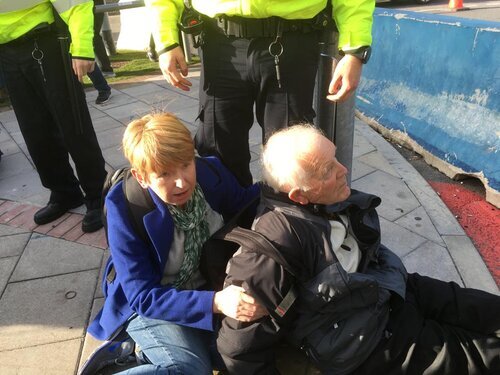
Sr Katrina with 83 year old Catholic activist Phil Kingston on a recent climate change protest
A Sister of St Joseph of Peace, Sr Katrina Alton CSJP, says: “It is a journey of the heart: a time for personal penance, reconciliation and conversion. With Jesus we enter the solitude and temptation of the desert, wrestling with our own complicity in the devastation of creation. It is also a collective journey of diverse actions in solidarity with our crucified earth, and especially the poorest people in the poorest countries already paying the price of the climate emergency.”
Sr Katrina cites ‘Querida Amazonia’ the Pope’s latest exhortation, as helping inform her commitment to the protest: “Pope Francis has defined ‘ecological sin’ not only as 'actions', but also 'inaction' that crucifies the poorest and the environment. The Pope goes a step further and says, "It is a sin against future generations." Our presence in Parliament Square for the 40 days of Lent will be a sign of our personal and collective commitment to make the sacrifices required to put pressure on our government to tell the truth and act now.”
Sr Katrina believes the Church could be doing more collectively, to put this issue at the top of the political agenda: “There are great examples of some dioceses, such as Middlesbrough, many parishes, and some religious orders who are leading the way on this. Good practice is out there, so we have no excuses! 2019 was the year of declaring a "Climate Emergency", 2020 has to be the year we see the transformative action needed to tackle it by our government, and by our Church.”

Christian Climate Action
The Church of England recently committed to reaching net carbon neutrality as an organisation by the year 2030 rather than 2045, the date suggested by the Church’s official working group on the question. Christian Climate Action were active in campaigning for the more ambitious 2030 timescale. The campaigning group have called for the Catholic Church in England and Wales to adopt the same 2030 target, beginning their Ash Wednesday vigil at Westminster Cathedral for this reason.
Reclaiming the politics of the common good: JPIC conference with Dr Anna Rowlands

JUSTICE PEACE AND INTEGRITY OF CREATION
JPIC-LINKS ANNUAL CONFERENCE
For Religious, Associates, Third Order Members & friends
17 - 19 April 2020
High Leigh Conference Centre,
Hoddesdon, Hertfordshire, EN11 8SG (Tel: 01992 463016)

‘Reclaiming the politics of the common good’
Led by Dr Anna Rowlands
Dr Anna Rowlands is the St Hilda Chair in Catholic Social Thought and Practice at the University of Durham. She is part of the Centre for Catholic Studies and also the chair of a national Centre for Catholic Social Thought and Practice. She works closely with a range of social justice organisations, nationally and internationally. She writes on political theology, Catholic social teaching and the theologies and philosophies of Hannah Arendt, Gillian Rose and Simone Weil and for the last 15 yrs has been working on theological responses to forced migration.
Programme outline:
Friday evening – Setting the scene, and opening reflection (Dr Anna Rowlands)
Saturday – Theological reflections and workshops (Dr Anna Rowlands)
Sunday – Eucharist, sharing our signs of hope and JPIC Links AGM
Residential: Friday supper to Sunday lunch: En suite rooms £160 /Standard rooms £130
Non-residential: £35 per day (includes Saturday coffee, lunch, afternoon tea & evening meal)
Non-refundable deposit £40
Note: The full amount needs to be paid by 15th March and there will be no refunds after this date
Queries and booking: Margaret Healy: margarethealyssl@gmail.com
For a Booking Form click HERE
Celebrating seven decades of Religious Life
“Like Simeon and Anna, those in consecrated life live more explicitly for the sake of the kingdom. It is at the heart of our consecration.”

Platinum Jubilarians


@Mazur/cbcew
An air of celebration pervaded this year’s Mass for consecrated life at Westminster Cathedral – which took place on the last day of the Scripture Road Show, part of the ‘The Year of the Word.’ Many took the opportunity to visit the ‘Tents of Meeting’ after Mass.
Looking at the example of Simeon and Anna in the day’s Gospel reading, Cardinal Nichols explained in his homily that, like Simeon and Anna, those in consecrated life “live more explicitly for the sake of the kingdom. It is at the heart of our consecration.” Read the full sermon here.

Golden Jubilarians

Diamond Jubilarians
At the celebratory lunch after Mass, Cardinal Nichols led tributes to those marking significant anniversaries of religious life this year – Silver, Golden, Diamond and even Platinum.
Among those attending was a new member of the Conference of Religious, the Superior of the Lebanese Maronite community in the UK, Fr Fadi Kmeid. Fr Fadi reports that his property search, which CoR highlighted before Christmas, is still ongoing.

Due to their growing numbers in London he and his small community are looking for a Church and residence, ideally in the west or northwest of the capital. They currently use a Catholic church, Our Lady of Sorrows in Paddington but have to rent a larger Anglican church for feastdays. The Maronites are part of the Catholic Church and they have three monks in the UK living in Swiss Cottage, serving 1500 families.
Fr Fadi (pictured front, right) can be contacted on : father@maronitechurch.org.uk Tel : 07908224983

Cardinal Nichols and the General Secretary of the Conference of Religious, Valerie Nazareth
Saturday, Strictly and Sr Anne

Glitterball in Sr Anne’s room

Sr Anne’s 91st birthday in early January
Sr Anne Kelly, who’s just celebrated her 91st birthday, must rank as one of the biggest fans of the television show, ‘Strictly Come Dancing.’ Sr Anne has watched every episode of Strictly that’s ever been broadcast and has an encyclopedic knowledge of all the dancers’ fortunes over the years. To prove the point, she’s even had a glitterball installed on the ceiling of her care home in the Midlands where she now lives!
Acknowledging it’s a slightly unusual obsession for an elderly nun, Sr Anne says she finds the spirit of fun and goodwill between the competitors in Strictly inspirational : “I love the variety and find it all so entertaining. I also love the approach of the judges when they praise the dancers but also give them tailor made advice on how to do things better. In a lot of these competitions there could be jealousy but with this, everyone’s pleased when another pair does well; it’s so lovely to see that spirit!”
A native of the west of Ireland, Sr Anne entered a convent at the relatively late age of 58, joining the Mater Ecclesiae congregation for older women. She’s a highly skilled laundress, who was known in the congregation for her dedication to perfection in that realm. She has recently moved from the mother house near Rugby to a care home in Coleshill and says her thoughts turn all year to when the next series of Strictly will begin, adding gleefully: “I look forward to those Saturday nights so much!”
Her other passion is devouring novels - she’s an avid bookworm. “I’m so blessed” she laughs: “I’ve got a wonderful memory, acute hearing and good eyesight as well as the gift of the gab! I’m pleased to say I’ve also got all my marbles!”
Happy Birthday Sr Anne - wishing you many more enjoyable episodes of Strictly!

Sr Anne, front left, at a Christmas lunch with two Mater Ecclesiae Sisters and friends
Divestment explained : one congregation's journey
“Our younger members who are good at campaigning were rightly questioning our strategy. We were all familiar with ‘Laudato Si’, and genuinely committed to issues of justice for the planet and all who inhabit it, especially those who are poor……..in the end the decision to disinvest was not a difficult one to take. We understood the financial risks and the ethical issues involved and were pleased to take the decision to divest.”

By Sr Frances Orchard CJ:

The decision of the Congregation of Jesus (Mary Ward sisters) to divest of our investments in fossil fuels was not taken in a hurry and only became a reality in mid-2019 – despite the growing and laudable encouragement from Christian NGOs and a very good conference on divestment held at Mount Street early in 2019. The reason for the tardiness was not primarily because 9.9% of our total investments were in fossil fuels, but because our investment managers were pursuing a policy of ‘engagement’ rather than ‘divestment’ by putting pressure on the fossil fuel companies in line with our CJ ‘ethical investment policy’.
The objective was to ensure that such companies did not pursue policies that were contrary to their commitment to the Paris Climate Accord to which they had ostensibly signed up. If certain criteria were not met, they were warned that divestment could follow. We were not acting alone. One of our investment managers has a ‘Stewardship Section’ with a ‘Climate Active Fund’ which managed the investments of those who had the same concerns as us. As with all companies the value of fossil fuel companies can be calculated by their expectations of growth and not simply their current assets. If fossil fuel companies calculate their value on their future production, they will not be able to fulfil their commitment to the 2015 Paris Accord and would send global warming well above the 1.5 ̊ - 2.00 ̊ safe limit. Despite promises of compliance the action did not follow.
In the end it was our exasperated investment managers who agreed that the time had come to divest. My only concern about divestment was that other less scrupulous investors would snap up our stock without hesitation and exploitation of fossil fuels would continue apace.
Meanwhile, our younger members who are good at campaigning were rightly questioning our strategy. We were all familiar with ‘Laudato Si’, and genuinely committed to issues of justice for the planet and all who inhabit it, especially those who are poor. I had attended COP15 in Copenhagen as an NGO in 2009 so was aware of the issues. There was some opposition from more senior members who had had a hand in building up our investment portfolio, but in the end the decision to disinvest was not a difficult one to take. We understood the financial risks and the ethical issues involved and were pleased to take the decision to divest.
We believe that divestment from fossil fuels is the right decision given the urgency of the change we need to see.
Sr Frances Orchard CJ
Provincial Superior of the Congregation of Jesus
Sisters in search of a home - and not for the first time
The Sisters moved, in August 2013, to their present location in Birmingham, just up the road from John Henry Newman’s first ‘Catholic’ home after his conversion, Maryvale. They are confident that their prayers to England’s new saint will lead them safely to their own new home soon.

l to r: Sr Barbara Claire, Mother Winsome, Sr Carolyne Joseph
The Sisters of the Blessed Virgin Mary, who are an Ordinariate community based in Birmingham, are looking for a new convent. The building they currently use is due to be sold and they are urgently searching for a property of the right size which will allow them to continue their ministry of offering retreats.
The Superior, Mother Winsome, says: “We’d ideally like to stay in the archdiocese of Birmingham but we’re open to suggestions. However with elderly Sisters it would be helpful for us not to be too remote. We’re hoping to find a purpose built convent, as a small-ish house wouldn’t be quite big enough.”
Their main source of income is through offering guest and retreat facilities, so they need a building that would accommodate eight Sisters plus allow space for guests. They would need some downstairs bedrooms or else a lift. As well, ideally, as a Chapel.
The Sisters of the Blessed Virgin Mary (SBVM) grew out of the Anglican Community of St Mary the Virgin, founded in 1848 in Oxfordshire. Following the establishment of the Ordinariate, the Sisters were received into the full communion of the Catholic Church on 1 January 2013 at the Oxford Oratory. At the time of their reception they adopted the Rule of St Benedict.
After vacating their former convent, they stayed for an initial period of monastic formation at St Cecilia’s Abbey on the Isle of Wight. Whilst there, an American Dominican, who was at that point staying at Maryvale in Birmingham, paid a visit. Mother Winsome explains: “We outlined our circumstances and said to the visitor : please go back to Maryvale and beg John Henry Newman to give us a home!”
On return to Birmingham the Dominican in question mentioned to someone that they’d encountered “some homeless nuns” and was told a convent was becoming available, just up the road from Maryvale. Mother Winsome had to act quickly to seal the deal: “I had just an hour to get off the Isle of Wight that day because of the times of the tides!” she recalled. Mother Winsome travelled to meet the outgoing Superior of the Birmingham convent - who was wondering what to do with all the contents of the property. Mother Winsome replied: “Please leave it all, we have nothing!”
There was the slight matter that the Ordinariate Sisters also had absolutely no funds to acquire the property - but, said Mother Winsome, “we were confident the Lord would provide!” Within days an anonymous donor stepped forward and the lease of the property was agreed. So they moved, in August 2013, to their present location in Birmingham, just up the road from John Henry Newman’s first ‘Catholic’ home after his conversion, Maryvale.
The Sisters are confident that their prayers to England’s new saint will lead them safely to their own new home soon.
If anyone could help with their property search, please email : sistersofthebvm@gmail.com
To read more about how Anglican Sisters became Catholic Sisters, visit: https://www.sbvm.org.uk/
New CoR members in search of a church and residence
“We are the only Church in the Middle East which was always in communion with Rome. We use the Syriac language – the closest dialect to the language used by Christ.”

Fr Fadi with his congregation
CoR is currently in the process of admitting the Lebanese Maronite congregation as new members and they have asked for assistance in finding a new church due to their growing numbers in London. They currently use a Catholic church, Our Lady of Sorrows in Paddington, and rent a larger Anglican church for feastdays. The Maronites are part of the Catholic Church and they have three monks in the UK living in Swiss Cottage, serving 1500 families.
The Superior, Fr Fadi Kmeid says: “The church we’re using is very small so we’re looking for a bigger place in which to worship, ideally something like a monastery where we could live as well.”
He adds: “We are the only Church in the Middle East which was always in communion with Rome. We use the Syriac language – the closest dialect to the language used by Christ. Ideally we are looking for a house with five or six rooms. Our congregation is happy to travel for an hour to be with us, but we think the best location would be ideally in Ealing/Perivale/Greenford or NW London. “
The Maronites have great faith in a Lebanese saint, St Charbel. He is known among Lebanese for his miraculous healings in answer to prayers said at his tomb. Fr Fadi says devotion to him is very strong: “He is a very active saint. He does a lot of miracles!”

Christmas Mass for the Lebanese community in Glasgow
The UK Maronite community is divided into two groups – the Cypriot Maronites and the Lebanese Maronites, who started to come to the UK after wars in the mid 1970s, with the biggest numbers of Maronite Christians arriving between 1988 and 1994.
There are around 7000 Maronites in the London area but Fr Fadi also ministers to Maronite communities in Bournemouth and Glasgow, with about 50 families in each place. Just before Christmas he travelled to Scotland and back, all in one day, to celebrate Mass for the community there.
He is pleased to report he has a very active London congregation, with a youth group, a Fraternity of the Immaculate Conception, altar servers, a choir and a family group which meets every fortnight.
Fr Fadi can be contacted on : father@maronitechurch.org.uk Tel : 07908224983
Celebrating thirty years of Christmas spent in the stable
“In London in particular, with the problems on the streets that we’re currently facing, to have a ‘rural’ environment in one of the largest cities in the world, is wonderful. It’s even more important now than when we started that there’s this little oasis.”

Sr Mary Joy (left) with a helper
A Religious Sister who has devoted three decades to running an inner city community riding school in London for the benefit of local children as well as the disabled, will be spending Christmas pretty much like the rest of the year – mucking out stables and tending to the animals.

For its 30th anniversary the centre had new stables in 2019
Sr Mary Joy Langdon of the Infant Jesus Sisters likes to quote the founder of her congregation, the 17th Century priest, Nicholas Barre: “Never stray far from the crib of Jesus.” For Sr Mary Joy it’s a case of never straying far from the stable – the location that has enabled her to support and educate thousands of children. Her dedication was recognised in the 2018 New Year’s Honours List. The riding school, founded in 1989, has gone from strength to strength and to mark its thirtieth anniversary has recently had new stables built.
Growing up in Sussex, with her own pony, Sr Mary Joy joined the IJS congregation in the early 1980s. “I hadn’t entered religious life to work with horses – but God works in very special ways!” she laughs. Her congregational leader encouraged her to use her talents and after moving to London she had the opportunity to open the riding centre on a rather unpromising patch of land close to Wormwood Scrubs prison: “There was nothing here at all when I first came. I started with three Shetland ponies and a muddy patch of ground,” she recalled. “No one around here knew about horses. Nobody in their right mind would have taken this on!”

Sr Mary Joy with HRH Princess Anne
However with the help of some volunteers the project developed. Now, as well as stables and a learning centre, there is also a large indoor arena. Conceding the work was a “little bit unusual for a Religious Sister” she says people happily accept it’s how she lives out her vocation. Sr Mary Joy says the growth of the riding centre has been a series of miracles with so many children with special needs having been nurtured there: “What a privilege to have helped them through their life. Another miracle is seeing children learning to walk through riding.” A number of those special needs youngsters have gone on to become staff members at the centre. “Children who are regarded as ‘non-achievers’ come here and start to achieve. It’s not all about riding either, we offer courses in feeding, grooming and fire safety: the ponies are a catalyst for learning.”
Another lesser known area of work is with people suffering from Alzheimers. Groups come and ‘meet’ the horses. Wheelchair bound people are brought into the stable area and can interact with the ponies which Sr Mary Joy says can be hugely beneficial and rewarding: “I recall two people from Jamaica recently who found the experience of being with the horses triggered memories. It was interesting to see how one particular pony who is ultra-sensitive to people went up to them in the yard, observing them in his own way. They were so totally relaxed with him. It was very special. Horses are very intuitive.”

Sr Mary Joy lives alone in West London. There’s no television at home but several pets as well as chickens. She keeps in touch with her congregation through being the person who updates their website as well as regular telephone calls. “When I was living in a community with other Sisters they might have found my work difficult to understand – for example, on Christmas day - but horses have to be looked after whatever the day and whatever the weather: ‘where’s Mary Joy? She’s at the pony centre!’ was a regular refrain” she remembers.
But at Christmas time Sr Mary Joy relishes the chance to spend her days in a stable, seeing her work as an expression of her spirituality and compassion for the less fortunate: “I think prayer is a way of life rather than part of life. I get in here at six-thirty in the morning. I love that time in silence with the horses and mucking out the stables. It is prayer, because it’s peace and spirituality, it’s contemplative in action. I struggle with formal prayers but prayer is with me nonetheless. I also meditate through writing poetry.”
Sr Mary Joy has no plans to retire anytime soon and her only complaint is that she’s so busy she struggles to find the time to ride. “The Infant Jesus Sisters congregation was founded for street children and to give them a better quality of life and that’s what we’re doing at the pony centre. The needs are different today but there’s still a great need, particularly around mental health. We’re seeing kids who are scarred from things they’ve seen; equine therapy can bring incredible results and ponies can really help the healing process. In London in particular, with the problems on the streets that we’re currently facing, to have a ‘rural’ environment in one of the largest cities in the world, is wonderful. It’s even more important now than when we started that there’s this little oasis.”

Green to the CoR
“Living our vocation to be protectors of God’s handiwork is essential to a life of virtue; it is not an optional or a secondary aspect of our Christian experience” (Laudato Si’)

Mater Ecclesiae, near Rugby, setting for one of the Laudato Si’ days of reflection
“Laudato si’, mi’ Signore” – “Praise be to you, my Lord”. In the words of this beautiful canticle, Saint Francis of Assisi reminds us that our common home is like a sister with whom we share our life and a beautiful mother who opens her arms to embrace us. “Praise be to you, my Lord, through our Sister, Mother Earth, who sustains and governs us, and who produces various fruit with coloured flowers and herbs”. (Laudato Si’)
Members of religious congregations in England and Wales are being called to reflect on ecological conversion, with the launch of a new CoR group devoted to the environment. Following discussions and reflection by congregational leaders at the 2019 AGM, Religious are being invited to consider how they can use their experience and resources to bear witness to the need to care for our common home:
“Living our vocation to be protectors of God’s handiwork is essential to a life of virtue; it is not an optional or a secondary aspect of our Christian experience” (Laudato Si’)
In some small way all of us can make a difference and in the Spring there will be days of reflection on Laudato Si’ where congregations will have the chance to come together and learn from each other about the vital and pressing challenge facing our world. The day is being repeated in three different locations and the keynote speakers will be Sr Margaret Atkins OSA, who is based at Boarbank Hall in Cumbria and Columban eco-theologian Fr Sean McDonagh. There will be input on practical ways to make changes by Steve Burrowes of the Laudato Si’ project in Salford diocese and John Paul de Quay of the Ecological Conversion group.

Sr Margaret Atkins OSA
Sr Margaret is in the process of making changes at Boarbank Hall and all those who attend the forthcoming meetings will be actively encouraged to set objectives for steps they can take in their own settings: “We have so far been concentrating on basic improvements to our heating system (cleaning out, insulation and then next will be individual thermostats ), tree planting (about 100 with the help of local schools - a Woodland Trust grant of baby trees for this), LED lighting for the Nursing Home, and eventually everywhere else,” says Sr Margaret. “What I realise is that with big old houses and often land to spare, we won’t ever have the energy ratings of a good new building, but if what we are looking for is improvement, we can do that dramatically with some very basic changes. We’re also doing smaller things - planting insect-friendly plants, bird boxes, looking at the possibility of a pond and some insect hotels .... And the primary school are going to do a project identifying and producing a display about our trees and wildflowers.”
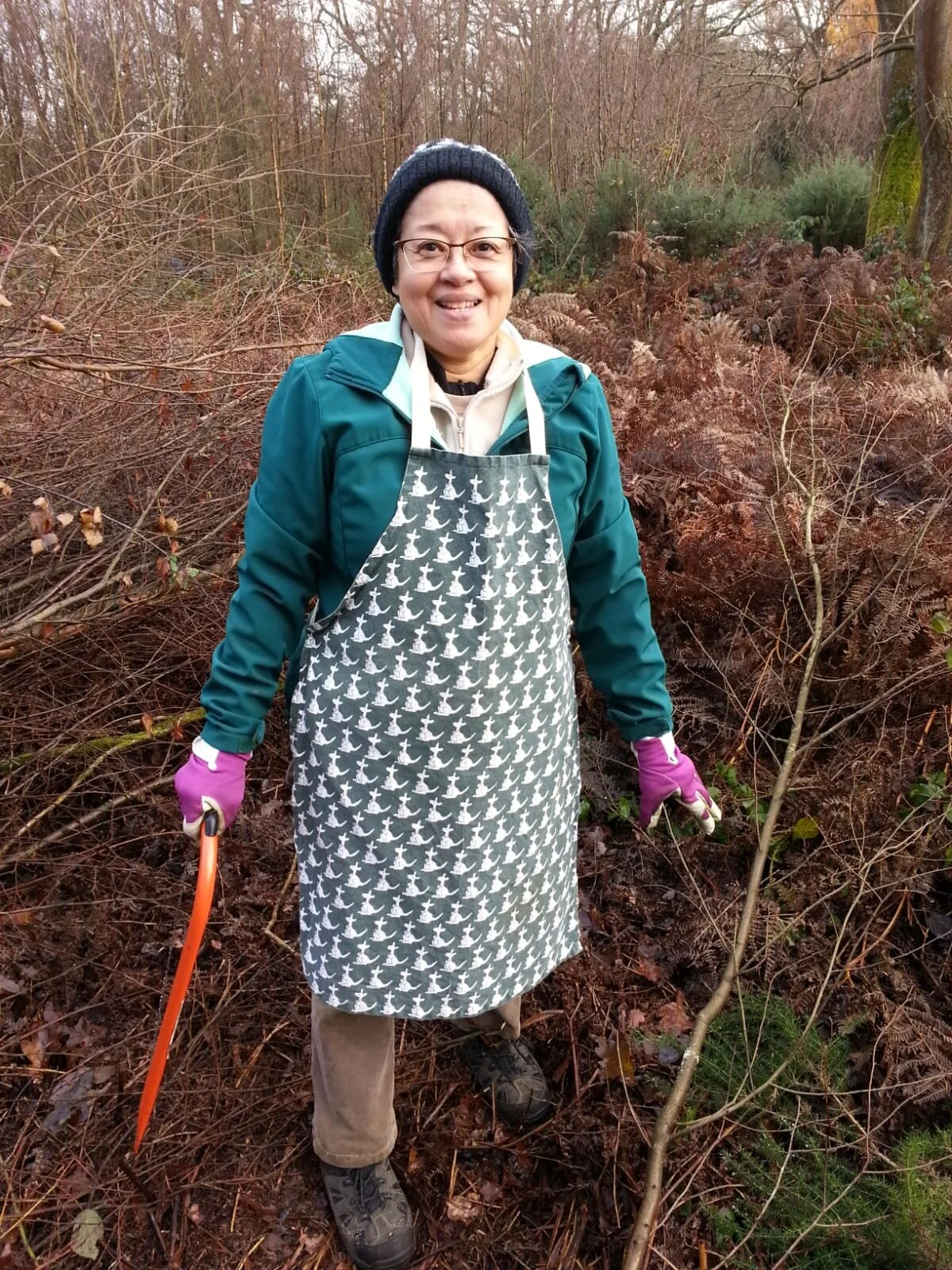
Sr Shirley
Another member of a congregation, Croydon based Sister Shirley Aeria FMDM, has made a conscious decision to shape her ministry around conservation and is an active member of the Ecological Conversion Group. Here she explains why:
“After reading Laudato Si’ when it was first published, it sat uncomfortably with me because I knew that I had contributed variously to the destruction of ‘our common home.’
But it was only further down the line, during my sabbatical, that the voice within me urged me to address the matter. I discerned the way forward and, with the help of a perceptive spiritual director, I was at peace knowing that conservation was the area where I would engage with ecology in a more direct way. I know that my involvement with conservation will enable me to live fully and give glory to God.

The Ecological Conversion Group of Arundel and Brighton was just beginning their project so I wrote to them and now I am working with them. The Croydon Conservation group has been in existence for over sixty years and I contacted them to see if I could be involved. I have been on several trips with them since.
Practical conservation work involves coppicing trees and bushes to enable healthy growth. It also means that we preserve the habitats of birds and wildlife and check on the status of trees, water sources etc,.
Going into conservation ministry has entailed looking at my own lifestyle and not just paying lip service to a novel concept. This implies giving up a car and using public transport instead, being conscious of how I use electricity and water as well as reducing waste, avoiding the use of plastic materials, eating less meat……
Ecology and the love of creation are the warp and woof of my life as a Franciscan. My present ministry in conservation opens me to various experiences and learnings. If every single person on this planet could do their bit, we must live in hope that our ‘common home’ will be able to recover from the dire state it is in at present.”
‘God called the dry land Earth… and God saw that it was good.’ Genesis 1:10

A recent reflection on Laudato Si’ by Sister Margaret Atkins:
Laudato Si' begins by telling us how it is: the state of our planet, and what our faith has to say about that. Chapter One uses evidence from the hard sciences to describe our world: pollution, climate change, scarcity of water, the loss of thousands of species. It does so, however, with a rhetorical power designed to make us care: 'The earth, our home, is beginning to look like an immense pile of filth.' 'The world is a joyful mystery, to be contemplated with gladness and praise.'

So, what does the Gospel have to say about creation? 'We are not God.' The world is the gift of our Creator, so that each creature is good and beautiful, and we are all interrelated. Indeed, our interrelatedness mirrors the Trinitarian nature of God. Our story, traced through the beginning of Genesis, is one of rupture. As we broke away from God, we also broke our peace with the natural world. Reconciliation with God, with each other and with the natural world are all part of the same process, the peace-making and healing that comes through Christ. Jesus himself knew and loved the Galilean countryside, its birds, plants and animals. And why would he not? - he, the Son of God, through whom all things were made, redeemed and restored.
The central chapters look at where we have gone wrong, and how we might go right. First, Pope Francis, closely following his predecessors, describes how we forget that we are not gods; we try to control everything ourselves. Pope Francis calls this 'the technocratic paradigm', from techne (skill) and cratos (power). We begin to see the world as there for us to manipulate. In practice, this means that powerful people take control. They control first others' things; then other people; then even the truth. Manipulation leads directly on to relativism - the truth itself is what I want it to be.
Technocracy fragments the world into manipulatable chunks. Laudato Si' reminds us insistently that 'everything is interconnected.' We have learnt that lesson from biologists: ecology is the science of the interconnectedness of life. The recent popes have taught that there is also a human, social ecology; and that this is inseparable from natural ecology. Indeed, a healthy personal and social morality, economics, politics and finance are all intermeshed with the well-being of the environment.
Finally, Laudato Si' leads on to action. We need effective dialogue, policy and action at every level: global, national and local. But before all else, we need 'ecological conversion', an inner, spiritual confession of sin, responsibility, praise and gratitude that changes our attitude and transforms our practice. This is indeed challenging. What it is not is grim and gloomy. Living more lightly and more generously is liberating and will bring us joy and peace at the deepest level.
But we Catholics should be inspired by, not ashamed, of our faith. It gives us all that we need to live lightly on the planet….. God the Creator and Christ who redeemed the world he entered and loved. The Holy Spirit, the Church and the sacraments to sustain us in hope. And a moral tradition that honours simplicity, justice, unselfishness and peace. We cannot save the planet by ourselves. We don't need to. We are not alone. We are interconnected, with God, with each other and with our world.
DETAILS OF DAY OF REFLECTION FOR RELIGIOUS (the same day is being repeated in different locations):
SATURDAY FEBRUARY 29TH : in Salford Cathedral Centre. Keynote speaker: Sr Margaret Atkins OSA with input from Steve Burrowes of the Laudato Si’ Centre, Salford Diocese
SATURDAY MARCH 14th : in London, venue to be confirmed. Keynote speaker: Fr Sean McDonagh, a Columban, with input from John Paul de Quay of the Ecological Conversion Group.
SATURDAY MARCH 21st: at Mater Ecclesiae convent, Street Ashton, Rugby CV23 0PJ - a beautiful rural setting, ideal for reflecting upon the environment! Keynote speaker: Sr Margaret Atkins OSA, with input from John Paul de Quay of the Ecological Conversion Group.
The days will run from 1000 to 1600 with lunch included. To register please email : admin@corew.org specifying which day you would like to attend.
Inspired by St Francis: a major international conference in Durham
“It was uplifting to be part of such a large and diverse Franciscan gathering, with a good number of younger people, and a powerful reminder of the crucially important resources of the Franciscan heritage, for the church and for the world.”

By Sister Sue Berry CSF:
I was one of 26 Anglican Franciscans able to participate in a recent conference hosted by Durham University Centre for Catholic Studies : “Assessing the Continuing Significance of St Francis and Franciscan Traditions of Theology, Spirituality and Action”. The event was sponsored by the Franciscan Families of the UK and Ireland and included speakers and delegates from around the world. Of the nearly 200 participants, around 100 were Religious, including 13 Anglicans: three Community of St Francis sisters, one Order of St Clare nun, and nine professed and novice brothers of The Society of St Francis, with two postulants. The other Anglicans were members of the Third Order, The Society of St Francis, which is similar to the Franciscan Secular Order in the Roman Catholic Church.

The particular stimulus for the Conference occurring at this time, was the eight hundredth anniversary of St Francis’ meeting with Sultan Malek Al-Kamil, which is being widely celebrated and used as a focus for joint activities and events to increase mutual awareness and understanding between Muslims and Christians. However, the broader more long-term aim was to explore the possibility of establishing an appropriate structure to enable a permanent Franciscan studies presence, located within Durham University’s Department of Theology and Religion. At the end of the conference leaders from a number of the Franciscan bodies met with academics from Durham and elsewhere to consider possibilities, and some of these are currently being explored further.
Much of the Conference was held in the splendid setting of Ushaw College now being run as a Conference and Events Centre, with the final day in the Students Union Debating Chamber near Durham Cathedral. One session was held in the University’s Calman Learning Centre, which provided the equipment for us to have a live session with Richard Rohr OFM, speaking from New Mexico on “Living Franciscan Spirituality Today: Digging Deep for Contemporary Renewal.”
The Conference encompassed a wide range of speakers and topics. We had lectures by Professors from various universities in the UK and abroad, including such authorities as Professor Ilia Delio OSF speaking on “Living Creation Theology in the Context of Contemporary Science: The Distinctive Contribution of the Franciscan Theological Tradition”, and Professor William Short OFM on “Bartholomew of Pisa’s Liber de Conformitate”. There were panel sessions on the meeting between St Francis and the Sultan, and on The Future of Franciscan Studies. In addition to the plenary sessions there was a Short Paper Programme where six different threads of Franciscan study were explored simultaneously in half hour sessions. This meant that we had over 40 such presentations to choose from which focused on aspects of Francis and Clare, but also included vignettes of Franciscan history in various countries and centuries, aspects of theology and spirituality from Bonaventure, Duns Scotus, Grosseteste and Angela of Foligno, Franciscans in English literature, and Franciscan insights relating to contemporary concerns such as ecumenism, interfaith and international relations, scandal in the church, and some of Pope Francis’ characteristic emphases.
The speakers were friars, sisters, church employees, established and newer academics, including an encouraging number of Ph. D students who are studying Franciscan themes in Durham, and other UK and European universities. A few of the speakers were Anglican Franciscan tertiaries, or lay members of Protestant churches. Although on paper the programme looked tightly packed and perhaps potentially confusing, I found the wide range of subjects and approaches very stimulating and surprisingly mutually enriching, and I think others shared that experience. The days were long, full and inevitably quite tiring, but full of energy and enthusiasm. The logistics were quite complex but the hospitality and organisation were excellent, and nearly everything ran without a hitch.
It was uplifting to be part of such a large and diverse Franciscan gathering, with a good number of younger people, and a powerful reminder of the crucially important resources of the Franciscan heritage, for the church and for the world.
During the conference an FMDM sister referred to their Congregation as very small, having around 200 sisters. I found myself reflecting that in Anglican terms that is huge. We in CSF are 23 in three continents, and our SSF brothers are about 140 worldwide. However, despite the disparity in numbers and resources, and differing ecclesial allegiance, I and my Anglican sisters and brothers are very aware of our shared Franciscan heritage, and eager that new and effective ways be found to pass on that vital tradition.
The senior staff from Durham University were clearly impressed by the numbers attending, and by people’s positive energy and enthusiasm. We wait with prayerful hope for a good outcome from the ongoing explorations regarding the possibility of some permanent presence for Franciscan studies in the university.
Sr Sue Berry CSF is the Anglican representative on the Conference of Religious Executive Committee

Sr Sue, far left, with Anglican Franciscans & the Archbishop of Canterbury at a previous international meeting
A place of welcome & peace in the midst of a busy city
“We want to give people the opportunity here to consider or find tools for making good life decisions, to search for justice, to pursue beauty as a revelation of God, find ways of caring for the Earth and to discover more meaning in their lives.”

Sisters in the Faithful Companions of Jesus congregation have opened an FCJ Spirituality Centre near Euston station in London. It has been developed in what was previously St. Aloysius Convent; the original building has been completely refurbished and two floors transformed into the Spirituality Centre.
By Sr Rita McLoughlin FCJ:
We hope to make our Centre a place of welcome where people can find peace, hope in the midst of a busy city, and the opportunity to reflect, learn, question their beliefs and deepen their faith. As well as providing a variety of events for the wider community we would like to be able to get to know our neighbours. We are delighted, therefore, to include in our programme two evenings on ‘Neighbours in Faith’, one on Judaism and the other on Islam.
We have already had several Day and Evening Retreats and we are offering a monthly Quiet Day. We have started sessions on Reflection on the Gospel of Luke and the Acts of the Apostles and are about to begin a series of Deepening in Faith Sessions. Our monthly ‘Film as a Way to Reflect on Life’, seems to be greatly appreciated and we are also offering the possibility of a Book Club.
Eco-Spirituality is really important to us. Some participants found our taster session in June an eye-opener and most inspiring! There will be 3 further sessions on ‘What is Eco-spirituality?’ in the coming months.
We look forward to a whole series of events on different ways of praying, including Praying with Clay, Colour Movement, Music and Poetry, while other creative sessions include, ‘The Gift of Laughter’ and ‘Card-making’.
We want to give people the opportunity here to consider or find tools for making good life decisions, to search for justice, to pursue beauty as a revelation of God, find ways of caring for the Earth and to discover more meaning in their lives.
We are happy to be already involved in spiritual accompaniment for quite a number of people and to offer the opportunity for making the 19th Annotation form of the Spiritual Exercises.
The geographical position and facilities of our Centre have been providing a helpful and easily accessible place to meet for many different kinds of groups and we are very grateful that we can offer this kind of service.
https://www.fcjsisters.org/news/our-new-spirituality-centre-in-london/
Theology and Practice of Safeguarding

By Fr James Leachman OSB
A year ago Ealing Abbey organised a day conference on, “Growing Together: Healing the History of child sexual abuse.” Father Hans Zollner SJ, head of the Centre for Child Protection at the Gregorian University in Rome, was the keynote speaker at that event.
Abbot Martin Shipperlee OSB opened the conference by speaking openly and honestly on behalf of the Church, “Yes,” he said, “we have made huge mistakes and the priests involved have been punished. Now, in order to move forward, we need to look critically at the system of the Church where these hideous crimes could flourish and we must take action.”
The monks of Ealing have been taking action - restorative action - in the months since the 2018 conference. The findings of the IICSA report about Ealing Abbey, published on 24 October, present an enormous task of restorative action and justice for Ealing Abbey to undertake - so that we can be truly accountable, make amends and to win trust back.
Practical action by Ealing Abbey throughout the past year led to a facilitated mini-conference in late October : “Growing in Connectedness: discovering the source of our power.” We invited ordinary Catholics, lay, religious and clergy and we spoke together of the shame, shock, confusion and pain inflicted on the innocent children, their families and the whole Church community. We are beginning to provide a place where victims and survivors, whether direct or indirect sufferers, now grown up, can find a place to be heard and cared for. We shall continue to meet every two weeks as a ‘Community of Practice,’ where we shall learn and study and act in the world.

Fr James inspecting an underground spring at Ealing Abbey ; as a symbol of new life, it is being diverted into gardens near the new ‘London Spring’ counselling
Ealing Abbey has also established a new initiative called “London Spring” where we offer subsidised low-cost counselling. Now, with Safeguarding structures in place, we believe we are beginning to create a new culture of relatedness and we intend to keep up the good work.

Also in late October, Father Zollner came and spoke at the Von Hugel Institute in Cambridge. It is encouraging to hear that the Church is now much more involved and more understanding of the problems that the Church today is facing and needs to deal with. He said that perhaps it is time to give the child and children their own voice, a theology of the child. How can we work together to create this?
If you’re interested in working in a group on “The Theology of the Child” please feel free to contact me: jl@jamesleachman.com