
Poor Clares on the move – along with their deceased Sisters

Photo: Beth Hughes
A community of nuns in rural Wales have just held a public auction of many of their monastery’s belongings as they await an imminent move which will see them exchange a rural lifestyle for city living. The Poor Clare Colettine Community has been in Hawarden for ninety years but in the face of mounting bills to restore and maintain their property they have discerned that the time is right to move to a Poor Clare community attached to a parish in Nottingham. The sale of their belongings, in June, was billed as a “unique, unrepeatable, amateur auction of ancient furniture, doubtful works of art, nunny junk, cloistered clutter, flotsam, jetsam, slightly off-white elephants and really useful odds and ends."

Flyer for "unique, unrepeatable" auction
Thirteen sisters will be setting off from Wales over the summer to join four sisters in Nottingham. An extraordinary aspect of the move is that they are also planning to disinter the 18 sisters in their cemetery for reburial in Nottingham. Speaking from the convent in Hawarden, Mother Damian was adamant that had to happen: “As a community we asked, ‘will we take the cemetery with us?’ Of course we will, we wouldn’t dream of leaving them here was the reply!” They have applied to the Home Office to get a license and are awaiting the disinterment, which will involve the convent’s cemetery being cordoned off and the remains being moved by hearse. Mother Damian explains: “Our cemetery is very special; they were the founding Sisters of this house. The cemetery is very much part of our lives. Many young sisters, when they first come here, walk into the gardens and then to the cemetery and spend a long time there in prayer.”
There is sadness at their departure from Hawarden and Mother Damian acknowledges that many local people have wondered why it has to happen. “We’ve had a wonderful life in Hawarden but we’ve come to realise that we can’t cope with the size of the property. The grounds are big but the infirmary is too small. Our boiler needs to be replaced and there is other major structural work to be tackled. The house is also full of stairs; we can see it will be harder for us here in five years, so we are looking to the future.”
They initially contacted the local bishop to see if he could assist in helping them find a new property. But then, after a visit to the community in Nottingham, the idea of moving suddenly took root. “We’d had contact with the Poor Clares in Nottingham for many years but it never entered my head that we would ever go there!” Mother Damian said. After praying about it, she offered the idea to her community in a vote and everyone said yes. She now has a “sense of peace” about the relocation and describes the move as like two hands joining: “We’ve never all lived together before. Like any merger, it’s bound to have its teething problems. But both parties are looking forward to the challenge. This is a new adventure, a new pilgrimage. God is setting us out to do something different. Each day we pray that God will bless this venture. But it’s not easy. I’m sure there will be many tears before it’s over!”
Mother Damian has lived in Hawarden since 1982 and believes the fact that the community never intended to go to Nottingham means that the sudden opportunity that has arisen is a gift from God. Alterations are being made to the property in Nottingham and the minute the builder gives the green light, the thirteen Sisters will be off: “God has given us an invitation and we have accepted.”
The deceased sisters will be reburied in the grounds of the Nottingham monastery. “They are a part of our community. They’re our roots; if it wasn’t for them, we wouldn’t have been here in Hawarden all these years.”
Plight of asylum seekers raised as a key concern
The Conference of Religious has added its voice to concerns expressed by Cardinal Nichols about the treatment of asylum seekers in the UK.
The Conference of Religious has added its voice to concerns expressed by Cardinal Nichols about the treatment of asylum seekers in the UK.
Speaking after a visit to the Jesuit Refugee Service (JRS), the Cardinal described the UK government's treatment of asylum seekers as "a shame on our country". After spending time listening to their stories he said, "If you're here for 10 years and you can't have a residence, you can't study, you can't work, you have no income, it’s as if you are being told you are a 'non-person', and it’s that darkness that we have listened to.”
His criticism echoes comments made by a number of Major Superiors at the recent annual general meeting of the Conference of Religious. Divided into groups to discuss the challenges religious are being called upon to tackle, the plight of asylum seekers was raised as a key concern, particularly by those who are regular visitors to detention centres. One Sister who is a skilled linguist thanks to years spent on overseas mission, described the “hostile environment” and “disbelief” about conditions, saying it “would break your heart.” Working with women who are the victims of violence, she says that after arriving in the UK they are traumatised again: “It’s very terrible that we as a country are doing this. I realise the UK can’t be the social worker of the whole world, but there must be a better way.”
“For these people, it seems like the system is out to not believe you ; it’s like you are guilty until proved innocent.” She assists women in basic care needs like writing notes on their behalf if they need to communicate with a doctor or lawyer. Arguing the case to give asylum seekers the right to work, she says both sides would benefit: “For many this process goes on for years and years. It’s such a loss of human potential. People say they want to contribute and pay taxes. The government would benefit as it would know exactly who and where these people are.”
Recalling the conversation at the Conference of Religious annual general meeting she said: “We all felt very passionately about this. In a prison, if you’ve committed a crime, you have a sentence. But these people don’t know how long they will be in there for or whether they’ll be sent back. It’s hugely stressful and some of them suffer illnesses due to the sheer stress.”
Sr Marie McDonald, of the Missionary Sisters of Our Lady of Africa, echoed those concerns: “The way asylum seekers and refugees are being treated is cruelly inhumane and a disgrace to U.K. The detention centres closely resemble prisons. Among other injustices they are not allowed to take on paid employment, rent accommodation, access free health care. As a result they are forced to depend on family or friends for shelter and many are sleeping rough. Landlords and employers risk being fined/imprisoned if they rent or employ an asylum seeker. The process to be given the right to remain here can last for years... Even when it is granted the Home Office can and does appeal against it which prolongs the agony even longer. These people have had to flee their countries and all that was familiar to them. They have spent months on horrific journeys across deserts and seas and finally when they reach here they discover that everything has been organised to make their life a living hell.”
On Thursday, after his meeting with refugees, Cardinal Vincent reflected : "I think being in this Jesuit Refugee [Service] Centre, is like just having a tiny light that allows you to see into the deep darkness of people's lives who are here in this kind of twilight world, and what we've heard this afternoon is how deep that darkness is. And in a way how deliberately that darkness is created, in a deeply mistaken sense that treating people this badly will prevent others seeking sanctuary in this country." In a podcast, he added: "I heard heart-rending, terrible stories of the way some people have been treated … we seem to have a system in place that obviously has to deal with some very difficult cases, some hard cases, but it seems to deal with all cases in a very hard manner. And it can't be right, it cannot be right, that a person is left in this limbo, this no-man's land, for 10 or more years in a country as sophisticated and as affluent as ours."
Sudan project offers model of collaboration for Congregations
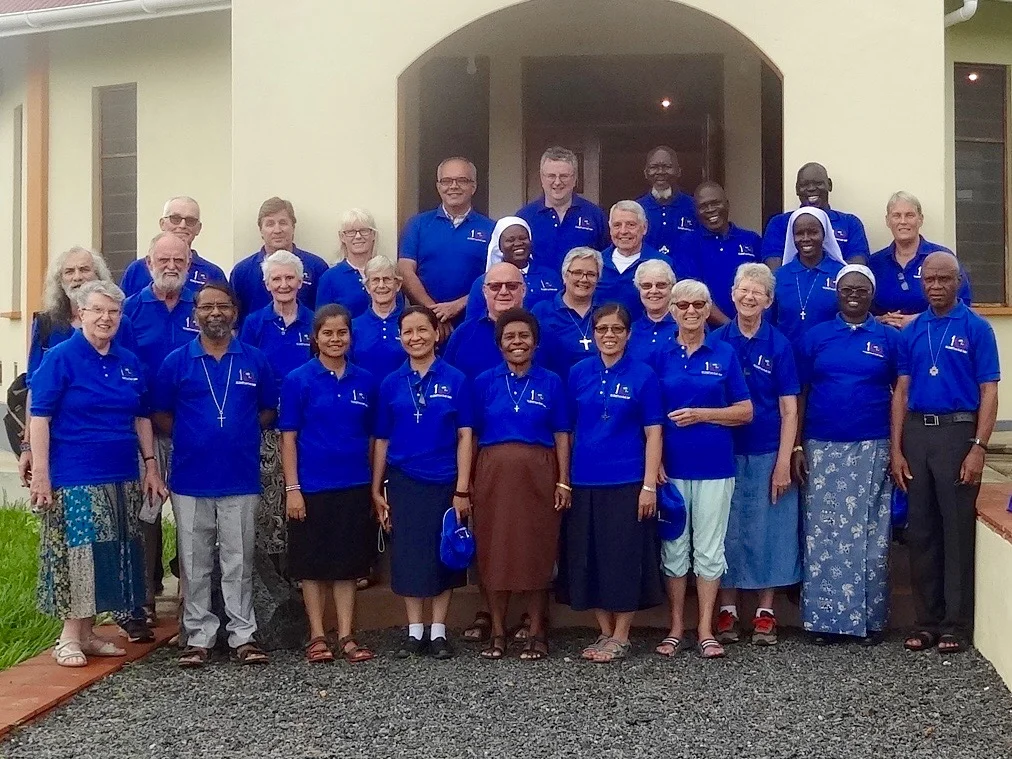
Solidarity with South Sudan
Fr Paul Smyth, back row, centre
The President of the Conference of Religious of England and Wales, Fr Paul Smyth, who is also President of the project ‘Solidarity with South Sudan’ - which has communities based in South Sudan made up of members from 19 different Congregations - has called on religious communities in the UK to copy this model of collaboration, in the face of emerging problems.
Fr Paul, a Claretian missionary, speaking just after returning from a two week visit to South Sudan, said the sharing of resources and personnel has allowed institutes and responses to be created that no single congregation would be in a position to provide – which can benefit those most in need and enhance the work of religious communities in alleviating suffering. He’s been involved in the South Sudan initiative since 2009. It was set up in response to an invitation from the Catholic Bishops of Southern Sudan and inspired by the 2004 Rome Congress on Consecrated Life, ‘Passion for Christ, Passion for Humanity.’
‘Solidarity with South Sudan’ has the objective of helping this country established in 2011, to rebuild after years of civil war. Its mission is empowerment and sustainability. It trains local people to become teachers, nurses & midwives as well as pastoral workers and catechists to support those traumatised by the conflict. In addition, there’s an agricultural project to produce food and re-introduce farming skills that have been lost due to people being displaced from their land and homes.

Thirty-two members of Religious Congregations from 18 countries and a diverse range of cultures live and work together: “The project is a sign of the work all religious are being called upon to do – to work together to respond to new needs coming up in our world and to share our resources” said Fr Paul. “It’s about allowing the differences we have to strengthen us. That should be a feature of all of us. For instance in the big multicultural parish I run in London we have to see how the mix can enrich us. The South Sudan project is one aspect of a pattern of other parts of my life.” He draws a parallel with the Conference of Religious, which draws together the Major Superiors of more than four hundred Congregations in England and Wales: “COR acts to foster collaboration amongst a large range of individuals and to encourage networking and shared responses.”
This approach is exemplified in the existence of the Medaille Trust, which was formed out of a conversation some 12 years ago at the annual general meeting of the Conference of Religious. Provincial Sr. Jane Maltby whose Congregation the Society of the Sacred Heart has gifted a large house in west London to the Medaille Trust recalls the origins: “Congregations came together over their concern about women and men who have been trafficked to England, and how to support them after they have been released. The Medaille Trust was a direct outcome of this and is supported financially by a large number of Congregations, some of whom have gifted a property to the Trust. The Medaille is now one of the single biggest providers of care for individuals who have been trafficked into the UK.”
Fr Paul adds: “Because of the Trust’s inclusivity of people of all or no faith, many whose lives are touched by its work may well be unaware of its origins. As a religious myself and the President of the Conference of Religious, the fruits of that meeting all those years ago is a living parable. A parable of what can happen when people of faith take the time to come together and support each other in looking at issues whose complexity tends to leave us individually feeling overwhelmed.”
The building of bridges is exemplified, he says, in the two Institutes that are being developed in South Sudan, for education and healthcare; a governance structure is being developed that builds on differences: “Both Institutes have people from the different states and tribes studying together. One of the country’s problems is the lack of social cohesion so the fact that we can show people working together is a sign of hope. People have expressed gratitude for that.”
Tributes pour in for British Loreto nun on being awarded MBE
Sr Imelda is President of RENATE
Sr Imelda Poole IBVM has described receiving her award in the Queen’s Birthday Honours as a “really great recognition” of the work being done by Religious in the field of anti-trafficking and an acknowledgement of the challenging work many “humble and hidden” people are involved in. Speaking from her base in Albania, Sr Imelda said becoming MBE still hasn’t hit home and she has been flooded by countless emails and by people constantly talking about it – “but I’m just ordinary me, getting on with a job!”
The award was given for her achievements and services to end modern slavery. Sr Imelda heads up a network of European Religious fighting trafficking and exploitation - RENATE. She became President of RENATE after more than 11 years working in Albania where the IBVM founded an NGO called Mary Ward Loreto.
Sr Imelda has been overwhelmed by the response from Religious involved in anti-trafficking globally and said that the award actually honours all the people involved in this work, noting that Sisters around the globe are involved in the struggle to fight traffickers: “despite the difficulty, they carry on as each human being is worth a lifetime’s work.”
Tributes have poured in following the announcement of the award. The British Ambassador to the Holy See, Sally Axworthy, expressed delight: “It is well-deserved recognition of Sr Imelda’s outstanding service in combatting human trafficking and modern slavery, through the European religious sisters’ anti-trafficking network RENATE which she leads, and through Talitha Kum, the religious sisters’ worldwide anti-trafficking network. Sister Imelda is a key ally in Her Majesty’s Government’s campaign to eradicate modern slavery. It is wonderful to see such a distinguished friend of this Embassy honoured in this way.”
On Twitter, the Archbishop of Westminster, Cardinal Vincent Nichols, who is president of the Santa Marta Group which works to prevent human trafficking and modern slavery, offered congratulations: “Sister Imelda, and her many colleagues in other religious Congregations, have long been champions in this important work. Her hard work, determination and her compelling advocacy constantly bring support and encouragement to all involved in this struggle, myself included."
The Mary Ward Loreto NGO in Albania has led to numerous projects being set up. One of these is called Mary Ward Loreto Women in which six Mary Ward centres have been established to work on prevention, advocacy, awareness, and rescuing of women. The centres have worked with 3,000 women, and set up 16 economic empowerment businesses. They also have a project for men aimed at changing patriarchal culture and promoting gender equality. The work with men is to address depression, anger and fear, drug and alcohol addictions related to unemployment and their changing role in society. Mary Ward Loreto is also promoting ethical and democratic best practice in Albanian schools and in all of the projects.
Sr Imelda recalled how it all started through a conversation with the Bishop of Tirana who pointed out that speedboats were being used to smuggle teenage girls into Italy. Years later, the work in Albania is still growing – a new shelter is about to be opened in the north of the country and Sister Imelda is still very active in the field; the conversation for this article had to wait until she had returned from a trip into the mountains.
Three different organisations in Britain have asked Mary Ward Loreto for assistance in helping women trafficked from Albania. One of the staff members based in Albania is currently working online to help Albanian women in the UK who can’t speak English. Also in the UK, a project is currently underway to survey Religious Congregations in order to map the work they are engaged with in the field of anti-trafficking. The Arise Foundation will be collating the results to produce a report in a few months time. Sr Imelda stresses the importance of building networks for collaboration and in receiving the MBE, paid tribute to other Religious: “In anti-trafficking, no one can work in isolation. This award is recognition of all of those we are working with. We rely on a massive number of networks.”
Reflecting on her many years in Albania, starting up the work from scratch, Sr Imelda says it’s been tough work, but also joyful and enriching: “We’ve taken many risks but I do feel it’s been step by step. There’s a sense of being led, of being nudged. As Hildegard of Bingen wrote, it feels like being a feather on the breath of God.”
Huge legacy of reality television programme at Norfolk Convent
The nuns who opened their doors to a camera crew for the making of the recent reality television programme ‘Bad Habits, Holy Orders’ say they’ve been overwhelmed by the response of viewers both in the UK and internationally. Speaking from her Convent in rural Norfolk, eighty-five year old Sister Thomas More said the Sisters have been inundated with letters and emails – all positive - and that some people have come back to Church after viewing the show.
The programme makers brought a group of hedonistic young women to live with the Daughters of Divine Charity and filmed them over the course of several weeks to see their reaction to being denied their usual lifestyle of partying, alcohol and social media. Sister Thomas More admits it was the first time a lot of the sisters had had such an encounter: “These girls have had an excess of drinking, of money. Some of them had the wrong goals in life. It was quite a shock to them when they arrived in the Convent!”
Sister Thomas More, who recently celebrated her diamond jubilee of religious life, said that when the Convent was first approached about allowing the cameras in she wasn’t at all sure it was a good idea: “I was worried. The younger sisters were more enthusiastic. But we talked it through and decided to go for it. It wasn’t particularly easy having the cameras around us morning noon and night. They weren’t inside our enclosure but they were in the Chapel and the common room.” The crew and producers even lived in the Convent for the duration of filming. “There were remarks about the lack of mirrors in the bedrooms!” she laughs.
That the programme impacted for the better on the lives of the young women is undeniable. “The experience led them to look at themselves and what they were doing. Not just their drinking. They’ve also come to see that there’s more to life.” Several have been reconciled with family members they’d fallen out with and the Sisters were delighted that a couple of them came back to the Convent to speak at a recent youth gathering.
The bond has been maintained, with one of the younger Sisters keeping in touch with the young women on Facebook. Sister Thomas More can’t hide her delight that the programme has led to the sisters expanding their ministry as well as their public profile. For instance some of them were recently invited to be involved in the running of an auction in aid of homeless young people. They’ve also spoken at a school in London on vocation and an invitation has just come in to speak in the Netherlands.
“In addition, we recently held a Convent open day. Forty-five local people came to see where the programme was filmed. Former pupils from our school have also reconnected and we were particularly touched that the parents of one of the young women who participated in the programme came to thank us for the impact it has had on her.”
The documentary is reported to be the first time in a decade in which programme-makers have been allowed to film inside a Catholic Convent in England and Wales. So has the experience of the filming been meaningful? “I would say so, yes. I never heard any of the visitors swearing. They respected us – which was lovely – you might not have expected to get that. We got quite fond of them and I think they got quite fond of us.”
Religious Sister Imelda Poole IBVM made MBE for her work to end modern slavery
Sr Imelda heads up a network of European Religious fighting trafficking and exploitation - RENATE.

Sister Imelda Poole, IBVM, has been made Member of the Order of the British Empire in the Queen’s Birthday Honours for her achievements and services to end modern slavery. Sr Imelda heads up a network of European Religious fighting trafficking and exploitation - RENATE. Sr Imelda became President of RENATE after more than 11 years working in Albania where the IBVM founded an NGO called Mary Ward Loreto.
Tributes have poured in following the announcement of the award. The British Ambassador to the Holy See, Sally Axworthy, said: “I am delighted to learn that Sr. Imelda Poole has been awarded this honour by Her Majesty The Queen. It is well-deserved recognition of Sr. Imelda’s outstanding service in combatting human trafficking and modern slavery, through the European religious sisters’ anti-trafficking network RENATE which she leads, and through Talitha Kum, the religious sisters’ worldwide anti-trafficking network. Sister Imelda is a key ally in Her Majesty’s Government’s campaign to eradicate modern slavery. It is wonderful to see such a distinguished friend of this Embassy honoured in this way.”
On Twitter, the Archbishop of Westminster, Cardinal Vincent Nichols, who is president of the Santa Marta Group which works to prevent human trafficking and modern slavery, said: "I congratulate Sister Imelda on her award, from Her Majesty the Queen, of the MBE for her work against human trafficking.” He added: “Sister Imelda, and her many colleagues in other religious Congregations, have long been champions in this important work. Her hard work, determination and her compelling advocacy constantly bring support and encouragement to all involved in this struggle, myself included."
Sister Poole joined the IBVM (Loreto Sisters) whilst still in her teens. She studied English and history at Manchester University and followed this with a PGCE in Theology and English. After her studies, she worked with disadvantaged people in Glasgow, London and Manchester before going to Kenya where she experienced life with the Kipsigi tribe. On her return to England she worked with marginalised people near Middleborough before later becoming involved with the campaign to eradicate human trafficking and modern slavery.
The Mary Ward Loreto NGO in Albania has led to numerous projects being set up. One of these is called Mary Ward Loreto Women in which six Mary Ward centres have been established to work on prevention, advocacy, awareness, and rescuing of women. The centres have worked with 3,000 women, and set up 16 economic empowerment businesses. They also have a project for men aimed at changing patriarchal culture and promoting gender equality. The work with men is to address depression, anger and fear, drug and alcohol addictions related to unemployment and their changing role in society. Mary Ward Loreto is also promoting ethical and democratic best practice in Albanian schools and in all of the projects.
The network of European Religious fighting trafficking and exploitation, RENATE, has a five-year strategic plan that includes combating human trafficking in all forms. It is currently focusing on child kidnapping and trafficking. In February, RENATE spear-headed the anti-child trafficking campaign in Europe for the day of Saint Josephine Bakhita, the patron saint of slaves.
COR AGM 2018 - Sr Pat Murray IBVM
Sr Pat Murray’s slide presentations from the 2018 AGM:

Please find attached Sr Pat Murray’s slide presentations:
The Narrative of Communion - Part 1
The Narrative of Communion - Part 2
and her notes in 3 attachments:
Conversation 2 and
The Day of Prayer for Vocations Sunday 22nd April 2018
This day flows from the broader culture of vocation, and is when the universal Church asks the Lord to send more labourers to the harvest.

The Day of Prayer for Vocations this year will be celebrated on Sunday 22nd April 2018. This day flows from the broader culture of vocation, and is when the universal Church asks the Lord to send more labourers to the harvest. The theme for this year is ‘It’s Your Call’.
The President, Executive Committee and the Secretariat wish you blessings for the Sacred Triduum and a joy-filled Eastertide

The President, Executive Committee and the Secretariat wish you blessings for the Sacred Triduum and a joy-filled Eastertide
UCESM - "WIDEN THE SPACE OF YOUR TENT" (Is 54:2)
“During these days we have had the opportunity to experience our unity through diversity.”

“During these days we have had the opportunity to experience our unity through diversity. Gathered together as the religious of Europe, we have heard the call of God and the Church, to go out towards the people in need.
We are deeply moved by the suffering of millions of displaced people who migrate from all over the world and within Europe. As UCESM (the Union of European Conferences of Major Superiors), we want to enlarge the space of our tent to welcome them.
Inspired by the Gospel of Jesus, moved by the Holy Spirit and the challenges we heard throughout our time together, we commit to continue to support the migrant population in Europe. Through respecting and defending the dignity and human rights of all migrants we will endeavour to address their needs through accompaniment, service and advocacy.
UCESM, comprising intercultural communities in the Church in Europe, commit to stand beside our displaced brothers and sisters in friendship and prayer. We also support everyone in their right to have a home. Our hope is to be open to each one with a listening heart.
We are all called to go out, to meet migrants, to take action as a congregation and from our communities where we are. It is by uniting on this global path of understanding and action that we will be a prophetic witness of God’s love to all people. By loving each other, including our neighbour and the other, the space of our hearts will be enlarged and our ‘tent’ will encompass many more.
Snagov, 9 March 2018
Centre for Catholic Studies 10th Anniversary Celebratory Conference

Catholic Theology in the Public Academy: Searching the Questions, Sounding the Depths
18 - 20 April 2018 in Durham, UK
Programme
· Academic Colloquium featuring James Alison, Tricia Bruce, Gavin D’Costa, Alana Harris, Nicholas M. Healy, Elizabeth Johnson, Kren Kilby, Paul Lakeland, Gerard Loughlin, Paul D. Murray, Anna Rowlands, Janet Soskice, Myriam Wijlens
· Celebratory Dinners in Durham Castle’s Great Hall and St Chad’s College
· Anniversary Mass of Thanksgiving in Durham Cathedral
· Public Lecture by Lord Daniel Brennan QC, ‘Catholics in Public Life—a UK perspective’
· Parallel Paper Sessions presented by postgraduate students, early career scholars and established academics on areas relevant to Catholic theology/ Catholic studies.
Registration and Further Details
A full programme, details of costs, and registration, are available from
www.centreforcatholicstudies.co.uk, ccs.admin@durham.ac.uk, or +44 (0) 191
334 1656. The registration deadline is Sunday 25 March 2018. Places are a
limited and we anticipate this will be a very popular event, so early booking is strongly recommended to avoid disappointment.
Archbishop Romero Trust
Ecumenical Service at 11.00am on Saturday March 17th at St Martin-in-the-Fields Church in Trafalgar Square. The address will be given by Ruben Zamora, Salvadoran diplomat who knew Romero well. (See attached)

12th - 19th March 2018 marks 10 years of Dementia Prayer Week

Spread the Word in 2018
This coming year is the tenth year of Dementia Prayer Week - we like to refer to it as a Decade of Dementia Prayer - will you join us?
Thank you for all your support to date. May you be inspired and comforted by the words of Bishop David McGough in March 2017, "During this week we remember especially the often forgotten pain of those suffering with dementia, and those who care for them."


World Day of the Poor - 33rd Sunday of the Year, 19 November 2017
In his message for the first World Day of the Poor, to be celebrated on 19 November this year, Pope Francis asks all of us, whatever our means or background, to unite in love, in acts of service to one another and in genuine encounter.
“It is my wish that … Christian communities will make
every effort to create moments of encounter and friendship,
solidarity and concrete assistance.”
Pope Francis


For the Victims of Terrorism
Loving God,
Welcome into your arms the victims of violence and terrorism.
Comfort their families and all who grieve for them.
Help us in our fear and uncertainty,
And bless us with the knowledge that we are secure in your love.
Strengthen all those who work for peace,
And may the peace the world cannot give reign in our hearts.
- Author Unknown


COR General Meeting 2016 – Dr Anna Rowlands
The presentations by Dr Anna Rowlands can be downloaded here:
The presentations by Dr Anna Rowlands can be downloaded here: